

Primary Times - the definitive what’s on and where to go family guide of activities and events for children of primary school age. Things to do with your kids during the school holidays including arts and craft activities, music and theatre for children, parties, competitions, days out, and family attractions along with term time drama schools, dance classes, after school clubs and sports activities. Things to do at a place near you!


Six UK schools launch pilot to tackle children's screen time
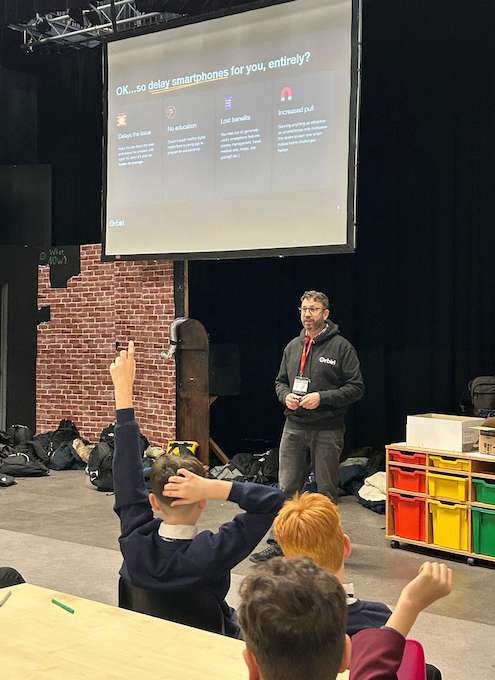 Six UK schools partner with Orbiri, a parent-founded system that brings families and schools together around shared digital boundaries, aiming to tackle screen time in school and at home
As governments and schools grapple with how to respond to rising concern about children’s smartphone use - from proposed school bans to under-16 social media restrictions - a new pilot programme across six UK schools is set to test a different approach: one built on collective action rather than simple prohibition.
Orbiri, a parent-founded technology company, has today announced its pilot phase in schools, in partnership with six primary and secondary schools across Surrey, Hampshire, and Hertfordshire. The pilot will test a community-powered system designed to help children build healthier digital habits and reduce the time they spend on screens, both in school and at home.
The pilot schools include Weydon School (Farnham), More House School (Farnham), St Peter’s CofE School (Farnham), Holy Trinity School (Woking), and Fearnhill School (Letchworth), with pupils, parents and staff preparing to move together around a shared framework for smartphone use.
Rather than banning devices outright or leaving parents to fight isolated battles at home, Orbiri enables shared digital boundaries across an entire school year group. The system organises apps and websites age-appropriately into clearly defined “Spaces”, such as School, Social Media, Play and Entertainment, each with set opening hours and daily time limits to support focus, rest and balance. During school hours, only school-defined learning and essential tools are available (for schools that use smart devices in class), while expanded allowances outside school hours allow families to adopt the same healthy boundaries principle at home.
Crucially, the same expectations apply to everyone in the community, transforming peer pressure from a source of conflict into a source of support.
The announcement comes amid intensifying debate around children and technology. In recent months, Australia has introduced a world-first ban on social media accounts for under-16s, while in the UK, MPs and campaigners have called for stricter controls on smartphone use in schools and beyond. Yet critics warn that bans alone risk driving behaviour underground, placing greater strain on families, schools and Ofsted, and failing to help children develop the skills they need to navigate technology responsibly.
Orbiri’s founders argue that while the intention behind measures such as social media bans is understandable, it won’t fix the broader problem: the time children spend on screens, how they spend it, and how families are left to address the challenge alone. That's because social media platforms are just one piece of a much larger ecosystem that keeps children glued to their phones, prioritising screen time over real-world play, connection, and adventure. What really needs addressing is how to enable access to the genuinely useful features of smartphones and other devices while protecting against apps designed primarily to consume users’ attention, resulting in dangerous levels of overall screen time - and doing that without turning parents into full-time enforcement officers locked in daily battles with their kids.
“The problem isn’t that parents don’t care or that schools aren’t trying hard enough,” said Jason Michaelides, founder and CEO of Orbiri. “It’s that we’re asking individuals to solve a collective problem. You can ban phones in one place or restrict one app for your own child, but unless children see the same expectations everywhere - at school, at home, with friends - the pressure and conflict simply resurface. Orbiri exists to close that gap and bring everyone along together.”
Michaelides added that Orbiri’s approach could play a crucial role if governments move toward tighter regulation: “If policy does shift towards social media restrictions or age limits, communities will need a practical way to implement those intentions in daily life. Orbiri provides the mechanism as part of a calm, consistent system that helps children learn overall digital balance.”
Participating schools see the pilot as a way to support wellbeing without escalating tension.
Ros Allen, Headteacher at Weydon School, commented on the upcoming Orbiri pilot: “I am delighted that Weydon School families have the opportunity to trial this cutting-edge technology which seeks not only to offer a pragmatic and workable solution to the thorny issue of children’s access to smartphones but also epitomises my commitment to working in partnership with parents to set clear boundaries around the use of smartphones for young people.”
Sarah Dunning, Headteacher at St Peter’s CofE School, added: “St Peter’s is pleased to be taking part in this pilot, which will explore how this technology can support families as they navigate the challenges of smartphone use for children of primary school age. It is particularly encouraging to see many local schools involved, including one of our feeder secondary schools. Working together in this way allows us to support families more effectively and help build a healthy, consistent culture around smartphone use.”
Meanwhile, Nicholas Fowler, Assistant Headteacher, Behaviour at Fearnhill School, comments on the importance of teaching long term healthy behaviour around smartphones, saying: “Mobile phones are brilliant, however they can be difficult for anyone to manage. At Fearnhill School we want to help our young adults manage their own mobile phone usage. Therefore, instead of banning mobile phones we are excited to be working with Orbiri to help our students learn to manage and control their mobile phone usage.”
Parent communications, forums and onboarding have already begun across Orbiri’s partner schools, with the pilot phase set to be completed by the end of the current academic year. As part of the programme, Orbiri will be reviewing anonymised insights on participation, focus and behaviour - never personally-identifiable usage data - to inform wider rollout later this year. Parents retain full control of their child’s device, and the system is privacy-first by default.
Founded by parents frustrated by daily screen-time battles, Orbiri isn’t simply another parental control tool, but a social solution powered by technology, one that recognises that children find it far easier to build good habits when they are not the only ones doing so.
As the global conversation continues, Orbiri’s pilot offers a live test of a simple premise: that healthy digital behaviour becomes possible when whole communities move together.