


Primary Times - the definitive what’s on and where to go family guide of activities and events for children of primary school age. Things to do with your kids during the school holidays including arts and craft activities, music and theatre for children, parties, competitions, days out, and family attractions along with term time drama schools, dance classes, after school clubs and sports activities. Things to do at a place near you!


Go All In - Making Up Stories Together
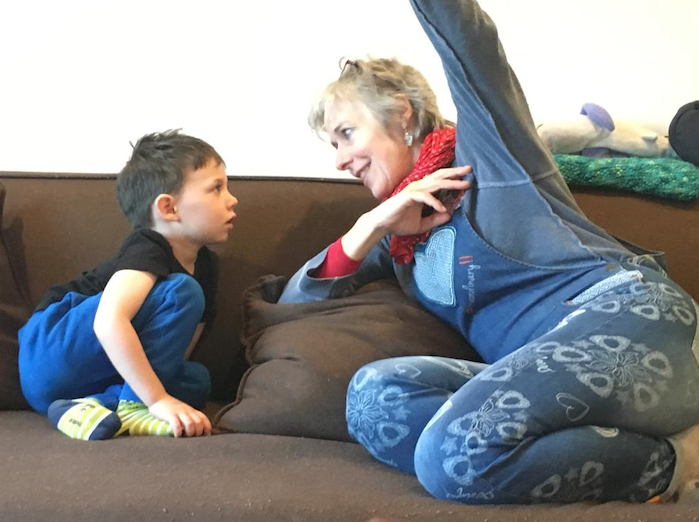 The art and joy of spontaneous storytelling
In this, *“Go All In - National Year of Reading, I’m delighted to see so much attention focused on books and reading. However, I am also aware that an overlooked, but essential, partner to reading and writing is the spoken word.
Oral storytelling underpins and sits alongside literacy, developing language, narrative confidence, listening, memory, empathy and imagination. Verbal skills and dexterity support us across our lives - from children’s early development to adulthood including interview techniques, speech making, presentation skills, building confidence and connection.
Stories shape us to understand who we are, where we’ve come from and what we’re capable of becoming. Stories help us to see the world more clearly. Throughout history, stories have been passed from one generation to the next, shared around our ancestor’s hearth and campfire long before the written word came into being.
When we listen to a good story we feel nourished by it. Stories awaken our thoughts, and feelings, opening the door to possibility and potential.
This is why I’m passionate about the stories we choose to tell to children as they are growing and developing, because the words we speak shape their future.
It’s also why I’m concerned when I read **stats that show that daily reading with children aged 0 - 5 has declined, with less than half of us (45.9%) reading to them daily. Ironically, we also know that in the UK 77% of families begin sharing books before their child's first birthday and that 95% of carers believe reading is important.
So what it the disconnect? It appears, from research, that the two main reasons we’re reading less to our young children are lack of time or low confidence in book selection…
When I speak with parents who feel squeezed by time pressures, are nervous about which books to read, or are overwhelmed by demands at the end of a busy day I suggest making up a short, simple tale without the aid of a book - not only at bedtime but also to help during the many - often fraught - transitions of a day.
*** The 4 Cs - Critical Thinking, Communication, Collaboration, and Creativity - are widely recognised as the foundational skills necessary for students to succeed in modern education, as part of the future workforce, and in daily life. All four of these skills can be found in and developed by spontaneous storytelling.
It might seem scary at first but one of the simplest and most powerful things we can do with children is to make up tales together. Here are a few ideas to help you do this, in a fun easy and way.
Try using an everyday item that’s close at hand to start a story, for example a toothbrush, hair slide, slipper, mug or teaspoon. Be inventive; the banana might be the sliver of a new moon, your fork could be a farmer’s pitchfork used at harvest time….
Pick up a stone in the park or on your walk to school. This can become so many things - an alien spaceship, a giant’s tooth, a sweet dropped by the ogre, a door to a hidden cave, the last potato before winter or the first potato in spring. Of course, as you begin to explore what this object might be, your child will join in adding ideas and suggestions. In this way you spark your combined imaginations, creating a satisfying and playful connection between you.
These made-up tales are all around you, ready and waiting to be seen… they’re perfectly imperfect, needing only your attention and your curiosity - no planning or perfection needed! These stories can be made-up as you get dressed in the morning, on your way to school, whilst waiting for a meal, on the bus or before an event, at bath time. Put your phones down and enjoy the moment of being together - the rewards will be exponential.
There are three main ingredients to what I call my P.O.P.P stories:
1. Person - the hero or protagonist of your story. This could be any character, an animal, supernatural being… but it’s someone who’s at the centre of your story. Decide together what your character looks like - maybe share one idea each and build… for example start with “they are tall and thin with green hair”. Someone else might add that “they have a large pointy nose with a wart on the end of it”. Keep recapping on what you’ve each described, using gestures to help remember each new description. “They have piercing green eyes and wear the most enormous red glasses”. Once you have 4 - 5 descriptors choose a name for your character. Maybe there are several suggestions so their name could be Ivan Roebuck Daisy Flump. Let this character grow between you… What is their favourite colour, car, food, who is their favourite friend? Your child could draw this character, or you could model them in clay together afterwards.
2. Place - where does your character live, or where do they want to get to? This is the landscape of your story. Ivan Roebuck Daisy Flump has to live somewhere. You could create this world in the same way as you created the character, or one person takes the lead… Do they live at the root of an enormous old tree which is over 1000 years old - or do they live in a castle under the sea? Wherever they live make sure you use what you see around you to inspire your story… including smells, sounds, how things feel or taste. Does Ivan like to eat mud pies, flavoured with dandelion seeds?
3. Object - something needs to happen to Ivan to make your story interesting. Some jeopardy! This could be a quest or challenge, there might be an obstacle to Ivan getting to the place they want to go or to find the hidden treasure. I suggest that you each choose an object - like the stone I spoke about earlier. The stone could be the wart on the end of Ivan’s nose… or it could be the hill they have to climb to find the lost parrot who knows the secret of…. what?
When you have these three ingredients you’ll find that your story takes on a life of its own, this is the fourth P - PLOT. Between you and your children you’ll be making up a story - it doesn’t have to be perfect, in fact imperfect is perfect. Remember that, like learning how to brush our teeth, the benefits come from the repetition. Make up stories together regularly, recognising that some will be satisfying whilst others will fall flat. However they turn out, the benefits are myriad, which increase with the repetition.
Use your imagination, but also your memory and your senses… Weave in places and characters you already know, stories you’ve already heard, smells and sounds you can hear around you.
Your children are likely to enjoy the silliness, the twists and turns, the challenges of creating a story together. What they’re likely to enjoy most is your undivided attention and you sharing your love and time with them.
Danyah is author of ‘Seven Secrets of Spontaneous Storytelling’ available online, in the library and in all good bookshops.
* Go All In - https://goallin.org.uk
*** https://www.marietta.edu/sites/default/files/documents/21st_century_skills_standards_book_2.pdf